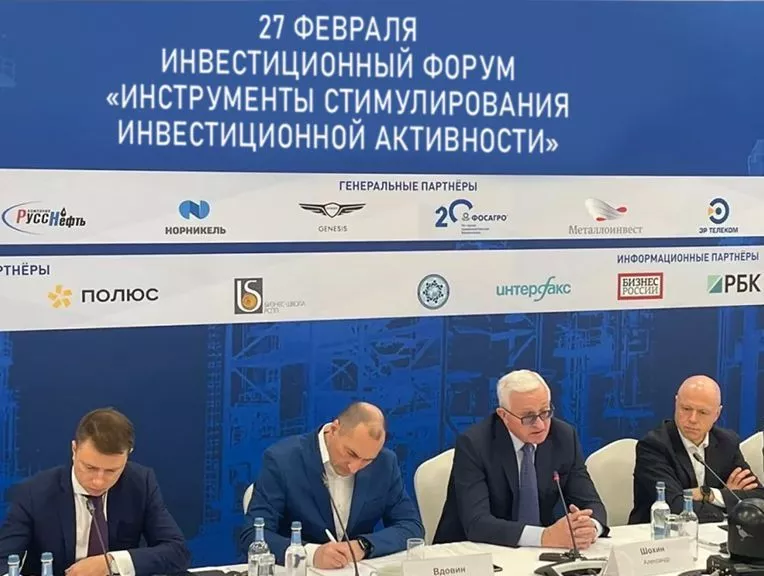


On February 27, as part of Russian Business Week, the investment forum "Tools for Stimulating Investment Activity" was held, organized by the Russian Union of Industrialists and Entrepreneurs. At the event, government officials, heads of leading Russian companies, and key development institutions discussed measures to attract extra-budgetary funding for infrastructure projects and stimulate business investment in transport construction.
The speakers at the forum included Anatoly Aksakov, Chairman of the Financial Market Committee of the State Duma of the Federal Assembly of the Russian Federation; Murat Kerefov, Deputy Minister of Economic Development of the Russian Federation; Dmitry Zaitsev, Auditor of the Accounts Chamber of the Russian Federation; Valery Krasinsky, Advisor to the Economic Department of Collective Investments and Trust Management; Sergey Kerber, Managing Director of Leader Management Company; Alexander Shokhin, President of the Russian Union of Industrialists and Entrepreneurs; Igor Vdovin, Member of the Board of the Russian Union of Industrialists and Entrepreneurs and Chairman of the Committee on Investment Policy, Development Institutions and Export Support; Igor Koval, Deputy Chairman of the Board for Investment Policy of Avtodor State-Owned Companies; Vladimir Kosoy, President of the Center for Infrastructure Economics; Alexey Andreev, General Director of JSC DSK AVTOBAN; Ruben Aganbegyan, First Deputy General Director of JSC Natsproektstroy Group of Companies; Konstantin Pesotsky, Senior Managing Director of the Key Client Lending Department of Sberbank; Alexey Chichkanov, Deputy Chairman of VEB.RF Yuri Korsun and others.
In his welcoming address to forum participants, RSPP President Alexander Shokhin noted that the primary way to counter sanctions is to boost entrepreneurial activity, including investment. As demonstrated by last year's experience, the Russian economy is capable of adapting to changing conditions, despite the emergence of new restrictions. To regulate the economy and support investment activity between the state and private sector, optimal cooperation between business and government is required. Without such collaboration, meaningful import substitution, infrastructure development, and reorientation to other markets are impossible. The RSPP President also emphasized the close relationship between infrastructure projects and technological development, making it crucial that import substitution be based on technological development rather than relying on parallel imports.
Igor Vdovin reaffirmed the need to be prepared for new challenges in today's environment. Furthermore, with the support of the Russian Union of Industrialists and Entrepreneurs (RSPP), the Association of Infrastructure Investors and Lenders was recently established at the initiative of major banks and infrastructure companies.
Igor Koval, Deputy Chairman of the Board for Investment Policy at Avtodor State-Owned Companies, noted that the banking community currently has liquidity and a willingness to invest fairly large amounts in transport projects. The main problem lies in the high interest rates and mechanisms for guaranteeing the return on investment expected from the financial community. He also noted that infrastructure investments generate the greatest impact on investment demand compared to other sectors: for every ruble of budget investment, there's an approximately 1.6 ruble impact on GDP and 0.15 rubles in direct tax revenues to budgets at various levels. The indirect effects of a new expressway (savings in travel time, improved road safety, agglomeration effects, etc.) account for over 30% of the project's cost.
Vladimir Kosoy, President of the Center for Infrastructure Economics, discussed the macroeconomic impacts in his speech. If there is a significant setback in 2023-2024, not only in new construction but also in preparatory work and design, there will be a significant decline in GDP growth and state budget revenue growth. Businesses, the expert community, and the government should jointly consider ways to develop new mechanisms for maximizing private investment.
At the end of the discussion, it was noted that in the context of ongoing economic instability, it is extremely important to ensure effective interaction between business and government, in addition to economic measures.
Instruments for stimulating investment activity
03|03|2023